Introduction to Food Microbiology and Safety
Survival Strategies of Gram-Positive and Gram-Negative Bacteria in Dry and Wet Environments
Bacteria have adapted to various environments over millions of years, with Gram-positive and Gram-negative bacteria displaying unique survival strategies in dry and wet conditions. This article explores how these differences impact their behavior in everyday environments, such as food factories and natural habitats, offering insights into their roles in microbiology and food safety.
Now, we will discuss the characteristics and differences between Gram-positive and Gram-negative bacteria, focusing on their adaptability to environmental conditions. Specifically, we highlight the significant distinctions between their survival strategies. Gram-negative bacteria, such as Escherichia coli, are not well-suited for dry solid surfaces and thrive in aquatic environments. For instance, during occasional investigations of E. coli contamination on university restroom doorknobs, I rarely detect E. coli. Instead, Gram-positive bacteria, such as Staphylococcus and Bacillus species, dominate these surfaces. Unlike Gram-positive bacteria, Gram-negative bacteria, like E. coli, struggle to adapt to dry surfaces like rubber or stainless steel, often used in food factories.

Survival and Proliferation of Gram-Negative Bacteria
Environments where Gram-negative bacteria, including E. coli, are more likely to survive and proliferate include cooling water tanks, wet floors, drains, and conveyor belts in food production lines where meat processing occurs. The presence of meat juices over extended hours creates a favorable environment for these bacteria. Modern sanitation practices in food factories effectively control Gram-negative bacteria like E. coli, but Gram-positive bacteria, such as Bacillus species, can persist due to their tenacity.
Evolution of Gram-Positive Bacteria
Bacteria evolved from aquatic to terrestrial environments, adapting to challenges such as temperature fluctuations and dryness. Gram-positive bacteria demonstrate remarkable adaptations to land. For example, Staphylococcus species inhabit the skin of terrestrial mammals, while Bacillus species thrive on plant surfaces. Another notable example is Clostridium botulinum, which evolved to survive in land environments by producing heat-resistant spores.
One distinctive feature of Gram-positive bacteria is their ability to endure harsh land conditions, including high temperatures, dryness, and salt concentrations. For instance, Staphylococcus species thrive on human skin, where evaporating sweat results in salt concentrations exceeding those of seawater.
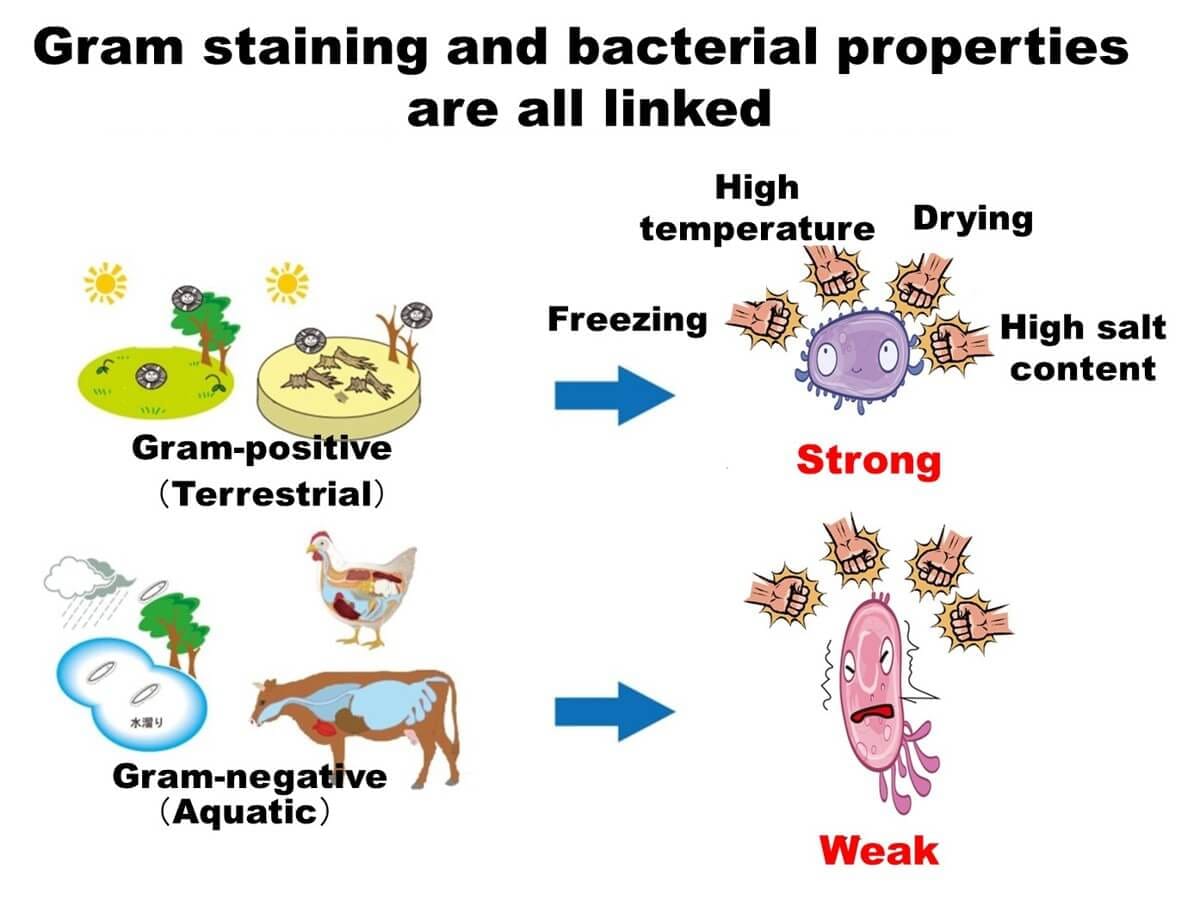
In summary, Gram-negative bacteria, such as E. coli, excel in wet environments but struggle on dry surfaces, while Gram-positive bacteria, such as Staphylococcus and Bacillus, have evolved to survive and thrive on land. Understanding these differences provides valuable insights into their behaviors and potential risks, particularly in food safety and environmental microbiology.
Related posts:
Microorganisms and Humanity: A Brief Encounter in Earth's 4-Billion-Year History (3) When studying food microbiology, it’s easy to focus solely on...
Food Microbiology: Understanding the Human-Microbe Battle (3) In this article, aimed at beginners in the fields of...
Why Don’t Lactic Acid Bacteria Have Heme? Unveiling the Unique Characteristics of Catalase-Negative Bacteria (3) In this article, we’ll delve into a unique question in...
Homo- and Heterofermentative Lactic Acid Bacteria (3) When it comes to lactic acid bacteria, we can divide...

Discover expert-led lessons in food microbiology designed for professionals and beginners alike.

Author of this Blog: Bon Kimura
Bon Kimura, Professor Emeritus at Tokyo University of Marine Science and Technology (TUMSAT), specializes in food microbiology. He obtained his PhD from Kyoto University and became a professor at TUMSAT in 2006, serving as Dean of the Faculty of Marine Science from 2012-2015. Kimura has published over 200 international papers on food safety, pathogens, and spoilage bacteria. He has received multiple awards, including the Japanese Society for Food Microbiology Award (2019). Kimura also served as an editor for the International Journal of Food Microbiology from 2012 to 2024, where he was the principal reviewer for 1,927 papers.

Copyright © Introduction to Food Microbiology and Safety All Rights Reserved.